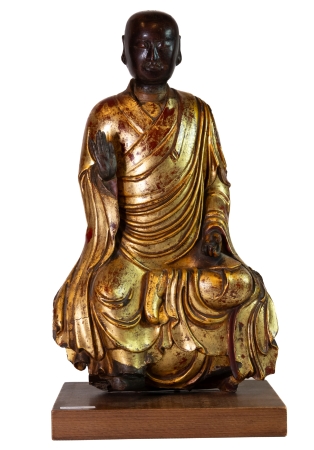


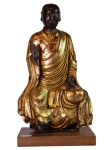
STATUE D’UN LUOHAN/ARHAT, DISCIPLE DE BOUDDHA. Chine, probablement dynastie Ming(ou Yuan) (1279-1644). Laque sèche rouge et or. Assis en lalitasana, maindroite en abhaya-mudra, main gauche tenant un joyau.
Inscription sur une étiquette (probablement XIXème-débutXXème) à l’encre noir « Yakushi Nyorai. / Healing Buddha / 8thCent. » (Peut être écrit par un marchand japonais).
-Tête : la tête est très probablementapocryphe et ne semble pas appartenir au reste du corps. Elle n’est pas enlaque sèche, présente un manque de finesse en comparaison avec le drapé de larobe, l’élément le plus frappant étant la bouche tordue.
Par ailleurs, le col suggère que la tête aurait dûêtre enfoncée de quelques centimètres de plus (autrement dit, le coup est troplong). Il semble également que le col a été restauré.
L’intérieur de la statue montre des traces de restauration à l’emplacement où lemembre (la tête) est inséré.
-Chaussure etpied droit : présentent des traces visibles de restaurations etrésidus des de colle. L’absence de dorure, comparée au pied gauche, suggère quela chaussure et le pied droit sont également apocryphes.
-Main droite: la main droit pourrait avoir elle aussi été remplacée. Les traits sont plusgrossiers, en comparaison avec sa main gauche, et on note également une absencede dorure.
-Main gauche: dégâts (manques) sur quelques doigts.
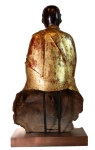
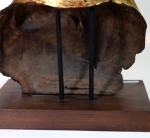
-Intérieur de lastatue un rectangle est visible àl’emplacement du dos. Il suscite des interrogations sur sa nature, laissant lapossibilité d’une restauration ou d’une fonction particulière, qui n’a pas pu êtredéterminée.
Il est probable que la statue ait été assise ou adossée àune monture. Monté sur un socle. 37,5 x21,5 x 12 cm
Conclusion : Il est envisageable que la statue ait subi des dommagesimportants peut-être en lien avec des mouvements antibouddhiques qui ont eulieu à plusieurs reprises en Chine et au Japon. On peut également penser à unaccident, surtout du côté droit où les restaurations sont concentrées.
STATUE OF A LUOHAN/ARHAT, DISCIPLE OF BUDDHA. China, probably Ming (or Yuan) dynasty (1279-1644). Red and gold dry lacquer. Seated in lalitasana, right hand in abhaya-mudra, left hand holding a jewel.
Inscribed on a label (probably 19th-early 20th century) in black ink: “Yakushi Nyorai / Healing Buddha / 8th Cent. (Possibly written by a Japanese merchant).
-Head: the head is most probably apocryphal and does not seem to belong to the rest of the body. It is not in dry lacquer and lacks finesse compared to the drapery of the robe, the most striking feature being the twisted mouth. Furthermore, the collar suggests that the head should have been pushed in a few centimeters further (in other words, the blow is too long). The neck also appears to have been restored.
The inside of the statue shows traces of restoration where the limb (head) is inserted.
-Shoe and right foot: show visible traces of restoration and glue residue. The absence of gilding, compared to the left foot, suggests that the right shoe and foot are also apocryphal.
-Right hand: the right hand may also have been replaced. The features are coarser, compared with the left hand, and there is also an absence of gilding.
-Left hand: some fingers are missing.
-Inside the statue, a rectangle is visible at the back. This raises questions about its nature, leaving open the possibility of restoration or a particular function, which could not be determined.
It is likely that the statue was seated or leaning against a mount. Mounted on a pedestal. 37.5 x 21.5 x 12 cm
Conclusion: It is conceivable that the statue has suffered significant damage, perhaps in connection with the anti-Buddhist movements that took place on several occasions in China and Japan. An accident may also have occurred, especially on the right-hand side where the restorations are concentrated.
Please note that we are still working on adding images for the lots. If the lot you are interested in does not have images available yet, we invite you to check again in a few days.
If you still cannot find the images you are looking for in a few days, please send us a message. Important: don't forget to mention the lot number(s).
Thank you for your understanding.